
3D Image Shows Flame Retardant Mimics Estrogen
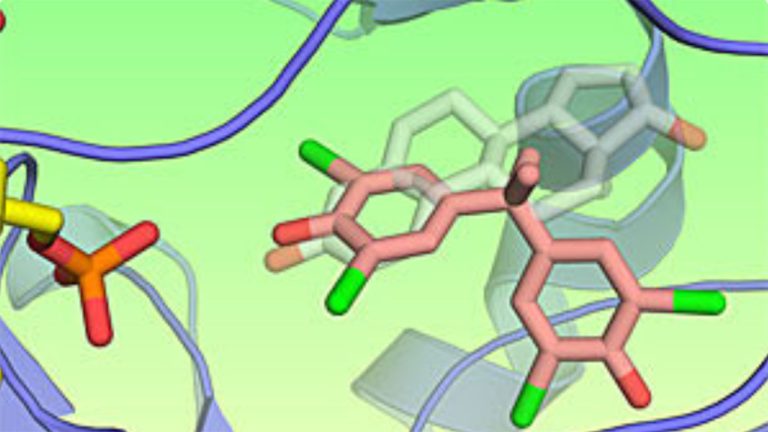
Some commonly used flame retardants, called brominated flame retardants (BFRs), can mimic estrogen hormones and possibly disrupt the body’s endocrine system according to a 2013 National Institutes of Health study.
The Article by the NIH is quoted verbatim here:
By determining the three-dimensional structure of proteins at the atomic level, researchers
at the National Institutes of Health have discovered how some commonly used flame
retardants, called brominated flame retardants (BFRs), can mimic estrogen hormones and
possibly disrupt the body’s endocrine system. BFRs are chemicals added or applied to
materials to slow or prevent the start or growth of fire.
“We’re beginning to have a better understanding of flame retardants and their effect on
human health. This particular study helps us literally see what brominated flame retardants
do when they get in the body — they interfere with the body’s natural hormones,” said
Linda Birnbaum, Ph.D., director of the National Institute of Environmental Health Sciences
(NIEHS), part of NIH, and National Toxicology Program (NTP). “Using the 3-D imaging
capabilities, we can see the flame retardants binding, or attaching, to proteins like estrogens
do.”
Birnbaum is an author on the new study which appears online in Environmental Health
Perspectives. She and her fellow researchers conducted the study in a facility jointly
supported by several NIH institutes.
Birnbaum, a leading researcher on flame retardants, joined with biologists and a
postdoctoral fellow to look more closely at one of the most widely used BFRs,
tetrabromobisphenol A (TBBPA). Earlier this year, NTP released data from a two-year
bioassay study, showing that TBBPA caused tumors in rats and mice.
“Having chemicals act like estrogen or other hormones disrupts how the endocrine system
works,” said Birnbaum. “In this case, the ability of flame retardants to bind to and inhibit an
enzyme that metabolizes estrogen, called estrogen sulfotransferase, could result in the body
having too much estrogen.”
The endocrine system is one of the body’s main communication networks and is
responsible for controlling and coordinating numerous functions, including growth and
development, reproduction, response to stress, and energy levels. There are hundreds of
different flame retardants. They are often broken into categoriesbased on chemical structure
and properties. BFRs, such as TBBPA, are used in many types of consumer goods, including
electronics, furniture, building materials, and automobiles.
Flame retardants are being studied, because of their pervasiveness and concerns about
possible adverse effects on the endocrine, immune, reproductive, and nervous systems.
For this study, the researchers used X-ray crystallography to build a 3-D model of the
protein binding to flame retardants. Crystallography allows researchers to look at proteins
at the atomic level. They examined how TBBPA and a metabolite, or derivative, of another
flame retardant called tetrabromodiphenyl ether, or BDE-47, compared with binding of
estradiol, a naturally occurring estrogen, to the estrogen sulfotransferase. Although many
flame retardants, including BDE-47, are no longer produced in the UnitedStates, some BFRs
are slow to break down and can persist in the environment. People can be exposed to flame
retardants through a variety of ways, including diet; consumer products in the home, car, and
workplace; and house dust.
“Using crystallography allows us to visualize exactly how these compounds can interact with
the body’s enzymes,” said Lars Pedersen, Ph.D., Collaborative X-ray Crystallography Group
leader at NIEHS. “Our results revealed TBBPA binding to the estrogen sulfotransferase at the
same position and in a similar manner as estradiol binds. Although there is much more to be
learned about how these chemicals and their metabolites impact different systems in the body,
every piece of the puzzle helps increase our understanding of the effects they may have.”
Researchers, like Pedersen and Birnbaum, hope the findings will be used by companies to
develop safer alternatives to current flame retardants.