
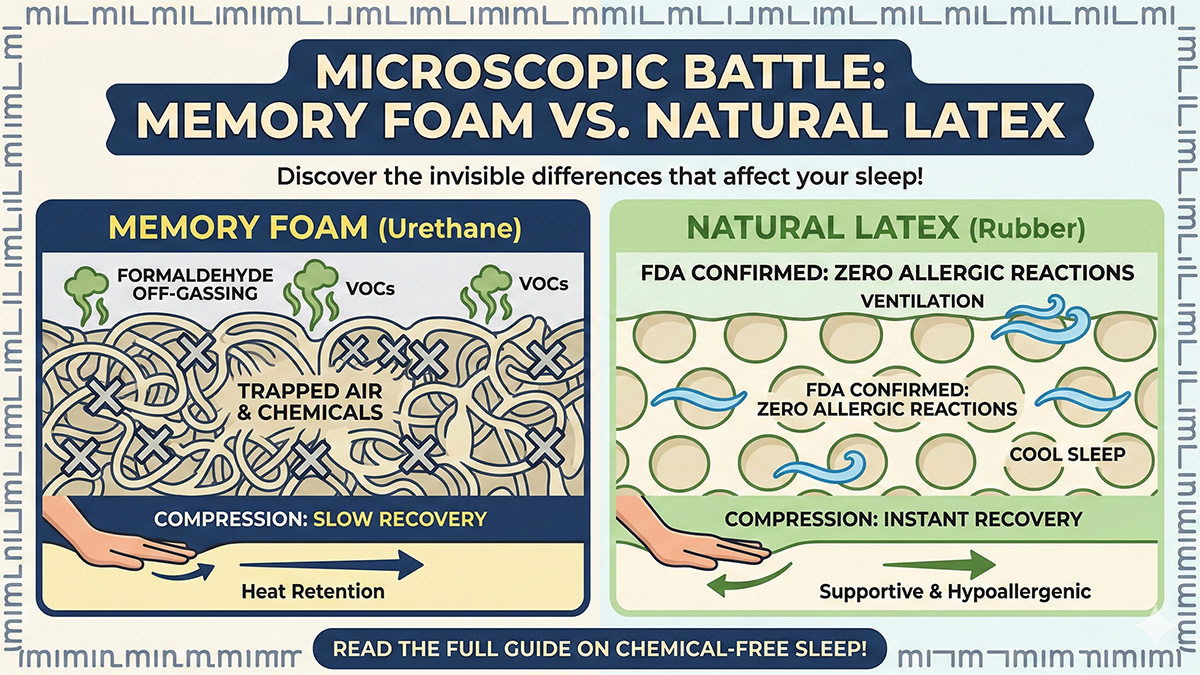
To answer your questions, does memory foam contain formaldehyde? What gives it the slow recovery properties and why when you saturate it with water it loses its slow recovery property? Yes, many memory foam mattresses contain formaldehyde. Formaldehyde is often a byproduct of the chemical reactions used to create the adhesives and surfactants within the foam. While some manufacturers claim to be “low VOC,” the manufacturing process of polyurethane (the base of memory foam) frequently involves various aldehydes and harsh chemicals.
What Gives Memory Foam “Slow Recovery”?
The technical name for memory foam is viscoelastic polyurethane foam. Its unique “slow recovery” comes from two combined physical properties:
1. Viscosity (The “Fluid” Behavior)
The foam contains chemical additives that increase its internal friction. When you press down, the polymer chains don’t just snap back like a rubber band; they move past each other like a thick liquid (think honey or molasses). This is the “visco” part of viscoelasticity.
2. Elasticity (The “Spring” Behavior)
The “elastic” part comes from the structure of the foam’s microscopic cells. These cells act like tiny balloons. When you move, they want to return to their original shape, but the viscous internal “friction” slows them down.
Why Water Destroys Memory Foam
If you saturate memory foam with water, it almost immediately loses its signature “memory” and slow recovery. This happens for two primary reasons:
The Plasticizing Effect
Water acts as a plasticizer. When water molecules enter the polymer matrix of the foam, they get between the long chemical chains. This reduces the internal friction (viscosity) that causes the “slow” movement. Essentially, the water “lubricates” the molecules, allowing them to snap back instantly or, more commonly, causing the structure to collapse entirely.
Cell Structure Damage
Memory foam is an “open-cell” structure. Water fills these tiny air pockets. Because water is much heavier and denser than air, it puts immense physical stress on the delicate polymer struts.
The Result: The foam becomes heavy and “dead.”
The Permanent Damage: Water can trigger hydrolysis, a chemical reaction that permanently breaks the polymer bonds. Once this happens, the foam will never regain its original supportive properties, even after it dries.
A Better Alternative: Natural Latex
Unlike memory foam, Natural Rubber Latex does not rely on these unstable chemical “viscous” additives. It is naturally springy, highly breathable, and does not off-gas formaldehyde. It provides “instant recovery” support that helps align the spine without the “stuck in the mud” feeling or the toxic chemical profile. Additionally, the materials in our latex mattresses have never been treated with any form or fire-retardants, so you know you won’t be sleeping in added chemicals to meet the unnecessary and despotic Federal fire-retardant regulations. To learn more about fire-retardants in mattresses, check out our website sleepessentials.com or watch our videos on our youtube channel.